Crosby Research Group

Overview
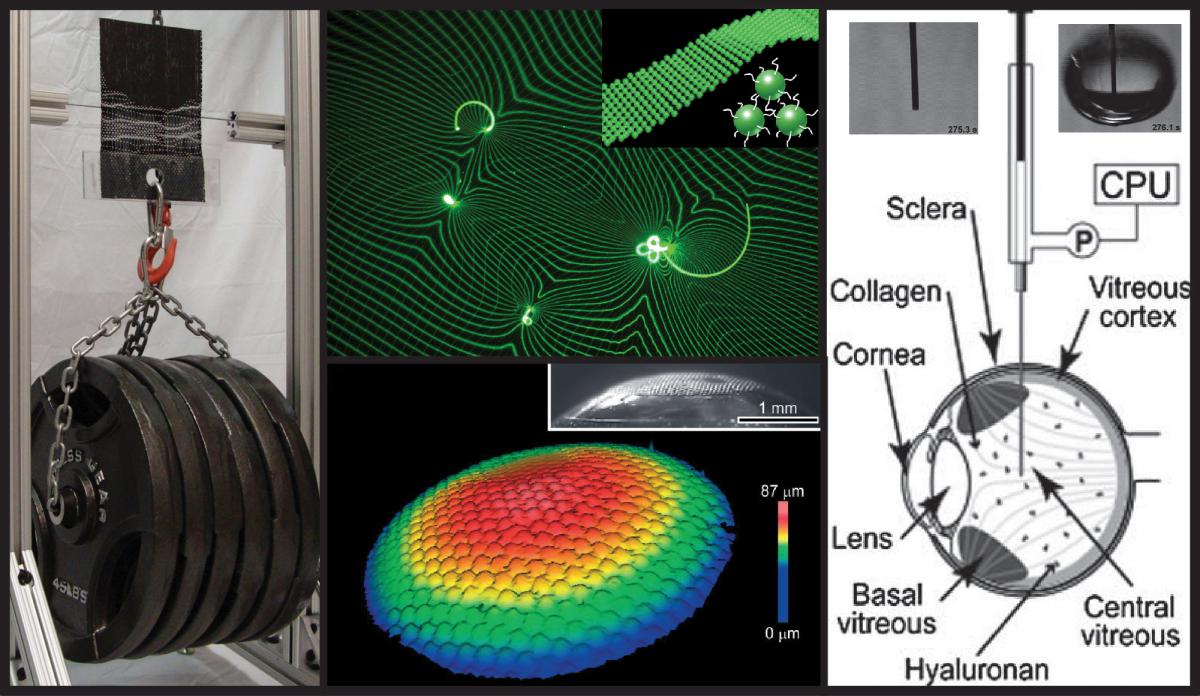
At the heart of nanotechnology and biotechnology is predictable control of materials' properties and function across multiple length scales. The concept of hierarchical design, or balancing geometry and materials on integrated length scales, allows for the development of materials that can optimize nominally contradicting properties without sacrificing performance. From the gecko to the Venus flytrap, beautiful examples of hierarchical design and fabrication are found in nature. Our group uses these and various examples in nature to inspire the development and understanding of hierarchical structures that display predictable materials properties. A poster summarizing our research can be viewed Here.
In addition to standard data processing and acquisitioning equipment, our group actively develops novel custom built instruments. The following equipment are examples of unique measurement and processing capabilities: Contact Adhesion Testing Device, Cavitation Rheology Instrument, Optical Profilometer, and the Flow Coater. Please contact Prof. Crosby with any questions about availability or use at crosby@mail.pse.umass.edu.
Snapping, Wrinkling and Folding Polymer Surfaces
Wrinkling, Crumpling, & Snapping Surfaces
Upon the development of a critical stress, many materials and geometries experience a mechanical instability, which produces significant changes in geometry with small changes in stress. In nature, mechanical instabilities are ubiquitous with the definition of shape, morphology, and function. Examples range from fingerprint formation to the snapping of Venus Flytrap. Inspired by these examples, we use elastic instabilities to control the morphology and function of soft polymer surfaces. In addition to studying the equilibrium and kinetically-trapped morphologies of wrinkling, crumpling, and snapping surfaces and film, we use these structures to biomimetically control properties ranging from adhesion to optics.
Responsive Materials
The ability to create materials that respond to stimuli in the environment is attractive for a range of applications from sensors to drug delivery devices. We take inspiration from nature to explore the balance of material length scales and geometry to develop"tunable" responsive materials.
Using solvent-induced wrinkling, we can create advanced optics, particle deposition templates, and microfluidic mixing platforms.
Our "snapping surfaces" not only demonstrate unique functionality in their ability to reversibly "snap" through an elastic instability and control properties such asadhesion and optics, but they open up a wide range of fundamental scientific questions on adaptivestructures.
Nanoparticle Stripes, Ribbons, and Ropes
The directed placement of nanoscale objects presents significant challenges to taking advantage of unique nanoscale properties within macroscale materials. Therefore our goal focuses on developing robust processing methods useful for assembling and distributing chemically-tailored nanoscale particles. To do this, we use the "coffee ring effect" with tailored ligand chemistry to assemble precise, complex, homogeneous or
heterogeneous, nanoparticle structures that maintain nanoparticle assemblies within macroscale structures. The nanoparticle assemblies are lifted to define flexible structures. Flexibility is defined by balance of core size, ligand properties, and particle packing.
Local Mechanics of Gels and Tissues
Mechanics of Swollen Networks and Living Tissue
We have developed Cavitation Rheology, a novel characterization technique that quantify the mechanical properties of soft materials such as hydrogels. Cavitation Rheology takes advantage of the unique elastic instability associated with non linear elastic materials. This instability is the growth of a bubble, or cavity, within a crosslinked network at a critical pressure related to the local elastic modulus. We are utilizing this technique to probe the mechanical properties of varieties of synthetic and living tissues.
Early Stage Tissue Formation
Several research groups, currently and in the recent past, have studied thedevelopment of mechanical strength at the interface between cells and synthetic materials. Most of this research has focused on either single cell interactions or the properties of mature tissues. We are guiding our research to investigate the development of mechanical properties during the early stages of tissue formation. We are also using thin film mechanics to quantify the residual stress, elastic properties, and adhesion of confluent cell sheets.
Non-Traditional Bio-inspired Adhesion
Adhesion & Friction
Nature has shown through numerous examples that patterns can be effective for tuning the strength of an interface. Building upon this inspiration, we have set a goal of understanding the primary performance-dictating mechanisms to provide feedback for rational design of materials interfaces. The hope is to develop bio-inspired synthetic materials for scalable adhesion control.
With this goal, we have developed a robust scaling relationship that clearly identifies the key, governing parameters for the maximum force capacity of a reversible adhesive. This scaling relationship has not only led to the development of a new adhesive technology but also to new insight into the enabling mechanisms behind unique biological examples, such as the gecko. Based on this insight, we work with Prof. Duncan Irschick in the Biology Department at UMass to demonstrate the importance of sub-surface structures, such as the direct integration of skin and tendon found in geckos.
See Publications: 45, 37, 32, 28, 25, 23, 20, 18
Selected Presentations
- "Deformation and Fracture of Soft Materials and Tissue." 2009 [pdf]
- "Living Microlenses." 2009. [pdf]
- "Wrinkling, Crumpling, and Snapping for Polymer Surfaces." 2008. [pdf]
- "Interfacial Control: Using the Laws of Nature." Adhesion Society, Austin, TX, February 2008. [pdf]
- "Nature's Instabilities: Inspiring Materials Design and Characterization." Symposium on Functional Polymer Based Materials, Jena, Germany, April 2007. [pdf]
- "Patterns, Polymers, and Adhesion." School of Polymer, Textile, and Fiber Engineering, Georgia Institute of Technology, Atlanta, GA, October 2006. [pdf]
- "Fundamental Insight into Deformation and Failure of Polymer Nanocomposites." International Symposium on Polymer Physics, Suzhou, China, June 2006. [pdf]
- "Adhesion of Patterned Surface: When do Players Become a Team?" NSF Indo-US Workshop on Nanomaterials, Pune, India, December 2004. [pdf]
Videos
- Surface Wrinkling Through Solvent Absorption Videos
- Cavitation Rheology Videos
- Snapping Surfaces
- Reversible Topographic Pattern Change
- A Wrinkle to Fold Transition of a Film Draping on Water


The directed placement of nanoscale objects presents significant challenges to taking advantage of unique nanoscale properties within macroscale materials. Therefore our goal focuses on developing robust processing methods useful for assembling and distributing chemically-tailored nanoscale particles. To do this, we use the "coffee ring effect" with tailored ligand chemistry to assemble precise, complex, homogeneous or
heterogeneous, nanoparticle structures that maintain nanoparticle assemblies within macroscale structures. The nanoparticle assemblies are lifted to define flexible structures. Flexibility is defined by balance of core size, ligand properties, and particle packing.
development of mechanical strength at the interface between cells and synthetic materials. Most of this research has focused on either
single cell interactions or the properties of mature
tissues. We are guiding our research to investigate the
development of mechanical properties during the early stages of tissue formation. We are also using thin film mechanics to quantify the residual stress, elastic properties, and adhesion of confluent cell sheets.